The Spacecraft Platform Company
The Spacecraft Platform Layer Powering the Constellation Era.
Everyday life on Earth depends on space, whether you know it or not.
In the last 24 hours, satellites helped you check the weather, navigate to work, communicate with others, fly across the country, or support those defending our country. Our lives do not just touch space — they rely on it. If today’s satellites stopped working, the world as we know it would grind to a halt.
At Apex, we believe space is already foundational infrastructure for Earth — and this is just the beginning. Space already supports the core systems that modern life depends on. The next era goes further: innovation, economic growth, and defense will move faster because of space, unlocking capabilities beyond what Earth-bound systems alone can achieve.
For most of space history, progress was measured in firsts: first satellite, first human in space, first Moon landing. Those milestones mattered. But the next era will be measured in rate: how fast countries and companies can deploy new capabilities, replenish what is lost, refresh technology, and expand the infrastructure they depend on.
That is the new Space Race: not a race for singular achievements, but a race for resilient infrastructure, industrial capacity, and continuous technology refresh.
To make that future real, the world needs constellations: many satellites working together as systems. That requires two industrial capabilities: launch and spacecraft platforms.
Launch is ready enough. Spacecraft platforms are not.
Apex exists to remove the spacecraft platform bottleneck.
Our mission is to expand humanity’s reach by delivering advanced spacecraft platforms that scale. In practice, that means making constellations rapidly deployable for the markets that need them most.
For most of the space age, launch was rare, expensive, and unforgiving. That scarcity forced missions to be slow, bespoke, expensive, and optimized around one big shot at success. The old model was not broken. It was built for a different constraint.
Then launch became more reliable, more frequent, and more available. Not necessarily cheaper from a customer-price perspective — demand for launch has remained enormous, and prices have risen. But launch capacity, cadence, and reliability changed dramatically.
A ride to orbit every year forces scarcity. A ride to orbit every day creates new models — but only if you have satellites to deploy. As launch became more available, the constraint shifted from getting to orbit to building enough capable spacecraft platforms to use orbit.
That is where Apex plays.
Constellations Are the New Architecture
Constellations are not just more satellites in orbit. They are a fundamentally different way to deliver capability from space.
With more satellites, you cover more of Earth more often. With systems closer to Earth and distributed across orbits, communications move faster. If one satellite is disabled or degraded, the rest of the constellation can help fill the gap. And when satellites are continuously replenished, new technology gets to orbit faster instead of waiting years for the next generation.
This is how space becomes rapidly deployable operational infrastructure: not one-off missions, not isolated assets, but systems that can be deployed, expanded, refreshed, and relied upon.
In defense, that means architectures that are harder to blind, difficult to disable, and faster to replenish. In commercial markets, it means new services can be deployed and improved continuously. For allied nations and emerging space powers, it means access to capabilities that once required decades of bespoke development.
The advantage is no longer only who has the best single satellite.
The advantage goes to whoever can deploy, sustain, and improve their constellations the fastest.
The Platform Gap
Starlink and Amazon Leo are prominent examples of the shift toward constellations: many satellites working together as a system rather than relying on a single asset. More broadly, constellation architectures can offer important advantages over single-satellite architectures, including greater coverage, lower latency, increased resilience, and faster technology refresh.
But these mega-constellations were built for narrow use cases.
Their spacecraft, payloads, network architecture, ground systems, software, and customer experience were designed together around one mission. They are not configurable platforms for the rest of the market.
Most critical space missions need a configurable platform approach. Governments, defense primes, allied nations, and commercial operators often bring their own payloads, ground systems, C2, software, customer relationships, or mission architectures. They need the benefits of constellation-scale deployment without building an entire vertically integrated space company around one use case.
That is the platform gap.
Apex is doing for the rest of the market what vertically integrated constellations did for their own missions: turning repeatability, integration, and scale into deployable capability.
That is the category Apex was built to define.
Build Once. Configure. Deploy Many.
A true platform creates a standard that many missions can build on.
For Apex, that means configurable spacecraft platforms, standard interfaces, clear specifications, integration processes, mission services, and the manufacturing system required to move customers from payload to deployed capability faster.
Apex does not build one-off platforms for every mission. We build an end-to-end, configurable product suite for markets that need constellations.
Apex says yes to missions where scale matter: missions that require many of the same spacecraft platforms, where speed, affordability, quality, and production capacity determine whether the architecture works at all.
Defense, intelligence, communications, sensing, science, commercial infrastructure — the specific mission can vary. The core question is the same: does this market need many satellites, deployed quickly and reliably? If yes, that is where Apex belongs.
Productization eliminates platform-level NRE, improves reliability, accelerates schedules, and creates the Apex flywheel: every platform we build makes the next one faster, more affordable, and higher quality. Volume compounds into learning; learning compounds into better platforms; better platforms win more missions; and more missions spin the loop faster. Every one-off change that breaks the platform resets the learning curve, reinforcing how repeatability becomes a structural advantage, not just an operating philosophy.
The flywheel compounds across product generations. Aries gave Apex flight heritage, production learning, and the foundation for our software and AI orchestrated company operating system, Octopus. Nova builds on that foundation with more capability, stronger price-performance, and a system designed for larger, more demanding customers. Each new vehicle and block upgrade inherits common interfaces, subsystems, software, production processes, and lessons from the last — then feeds improvements back into the platform through block upgrades.
The factory is not separate from the platform: it is the core of the platform. A productized spacecraft, Octopus, and a repeatable production model make it possible to scale beyond a single facility. Over time, Apex extends this model through a global network of Apex-enabled factories — all building from the same standards, software, interfaces, and quality system.
Customers should differentiate on payload, mission, CONOPS, software, and capability — not on custom platform development that slows them down before they ever get to orbit.
We standardize everything that should not be unique, so customers can focus on what must be.
That is how a product becomes a platform. And that is how a platform becomes a standard.
The Apex Industrial System
Moving at constellation speed requires more than a spacecraft platform. It requires an industrial system.
Apex vertically integrates because the logic of the mission demands it: speed, reliability, affordability, quality, and time to market require control over the systems that determine whether customers can deploy on schedule.
Octopus, our proprietary company operating system, connects business development, product, finance, engineering, supply chain, manufacturing, test, and delivery. It gives Apex the control, traceability, and operating rhythm required to build spacecraft platforms repeatedly, reliably, and at speed.
This is the Apex Industrial System: vertically integrated hardware, software-orchestrated operations, and a factory built from day one to scale. Vertical integration controls the parts. Closed-loop industrialization controls the system — and lets the flywheel spin faster.
The Apex Way: Own the Risk
Speed is meaningless if customers pay the price for it. That’s how the satellite industry works. That’s not how Apex works.
Every new spacecraft platform begins as an Apex Testbed vehicle. We move aggressively — designing, building, flying, learning, and iterating as quickly as possible. We “test like you fly.” We also believe in something equally important: learn in flight. Ground testing can only take you so far. Space is the final test environment.
We intentionally take that risk ourselves and launch Apex-owned spacecraft early in every product family to expose issues, learn quickly, and improve the platform. Those are our risks to take — not our customers’. When we encounter anomalies, we solve them, fly again, and keep learning until the platform is ready.
Customers don’t wait to buy the platform. They know that by the time their mission launches, Apex will already have proven it in orbit.
This philosophy is why Apex moves quickly without asking customers to accept unnecessary risk. We move at an unprecedented pace. We absorb the learning. We fly again when necessary. Only after the platform has proven itself do our customers become the first to fly it on their missions.
Design, produce, test, learn, iterate… Apex absorbs the risk, and then passes the proven spacecraft platforms to our customers.
We absorb the risk so our customers inherit proven spacecraft platforms. That’s the Apex Way.
From Platform to Mission
The platform lays the foundation. Mission Integration Engineering takes the foundational platform and turns it into the backbone of a customer mission.
Productization does not mean every mission is the same. Customers bring unique payloads, requirements, interfaces, CONOPS, and constraints. Apex’s Mission Integration Engineers keep the platform sacred, while helping customers connect payloads, resolve interfaces, reduce NRE, and accelerate qualification. By keeping the platform constant and engineering the payload-side compatibility, we help customers get from payload to deployed constellation, fast.
For some customers, that means a spacecraft platform and integration support. For others, it means software, communications, ground, operations, and more of the end-to-end mission stack. Apex meets customers where they are while keeping the platform productized.
As the platform becomes the core of a constellation, there will be missions where Apex should selectively own the entire stack — including prime responsibility — because doing so makes the mission faster, more integrated, and more deployable. We will be selective. The goal is not to chase every mission; it is to own the missions where the scale of the platform is the key to making the constellation real.
Standardize the platform. Integrate the mission. Deploy at constellation speed.
Proof in Orbit
This is not theoretical.
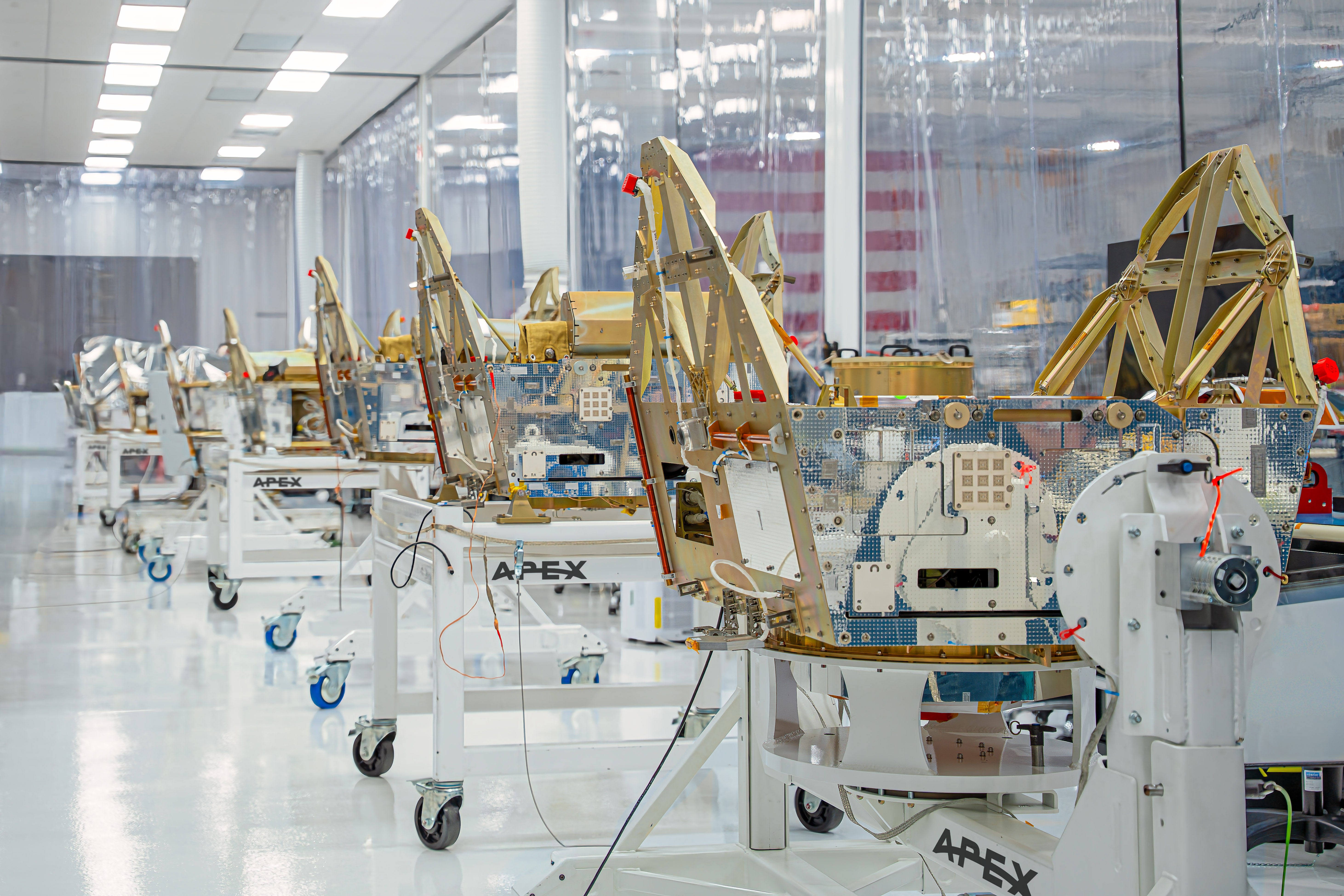
Apex has already proven that a productized spacecraft platform company can move faster than the traditional model without sacrificing quality. The first Aries went from clean-sheet design to orbit in under 12 months and has operated on orbit for over two years. Since then, Apex has achieved 100% customer mission success and delivered over a dozen platforms to customers, while continuing to ramp Factory One production to over 200 platforms per year.
Speed is not the antithesis of quality when speed is achieved through repeatability.
We are not just designing satellites. We are building the platforms, factory, software infrastructure, supplier base, mission integration capability, and operating model required to make constellations rapidly deployable.
Apex’s Strategy
The strategy is simple, but difficult: own the world’s spacecraft platform category.
We do that by empowering exceptional talent to build an end-to-end product suite for markets that need constellations; scale ahead of demand through vertical integration; and win on speed, reliability, and affordability.
We stay focused by refusing to chase every custom opportunity.
By enabling our customers, humanity’s reach expands. Space infrastructure becomes deployable, not theoretical. Constellations become accessible to customers who could not — or should not — build the entire stack themselves.
Space is becoming foundational infrastructure for humanity.
The next era depends on making constellations rapidly deployable.
The world does not need another satellite manufacturer.
It needs the spacecraft platform company that makes constellations possible.
That is Apex.